

Applications
Diagnostics.
Thermal control
on the strip itself.
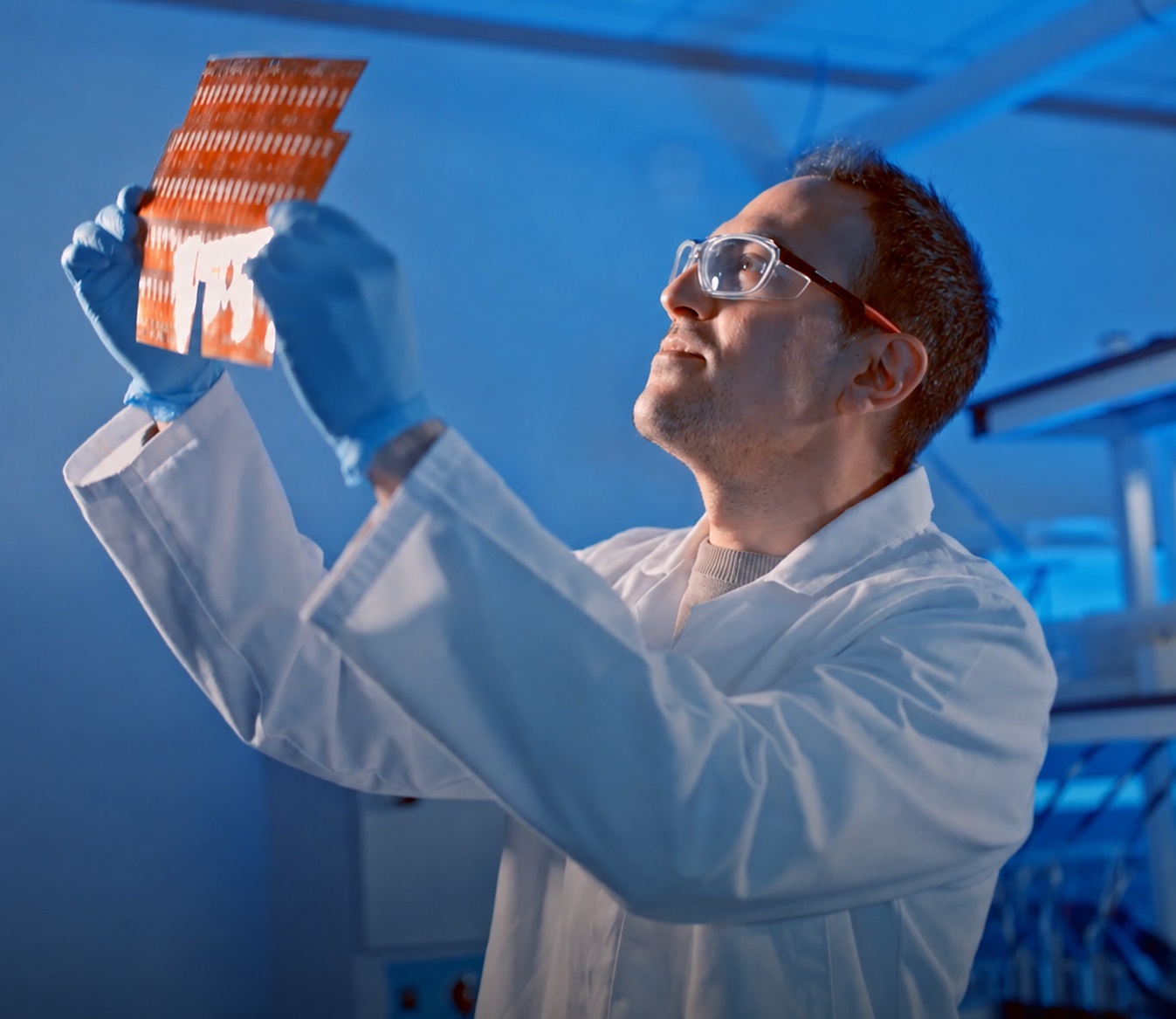
Molecular diagnostics need precise, repeatable heat in a disposable device. Gii heats fast, evenly and at low voltage, so amplification, lysis and incubation steps can run on the cartridge instead of in a benchtop instrument.
Where Gii is used
Diagnostic thermal steps built on Gii
Five places where an integrated heater removes an instrument or a manual step.
Nucleic Acid Amplification
Thermal cycling for PCR and isothermal holds for LAMP, driven by an element with very low thermal mass.
Lysis and Sample Prep
Controlled thermal lysis and elution steps performed on-cartridge, removing off-device sample handling.
Assay Incubation
Stable, uniform incubation temperatures that tighten coefficients of variation in immunoassay formats.
Reagent Conditioning
Dried reagents rehydrated and brought to temperature quickly, shortening time to result.
Combined Heat and Sense
Heating elements and Gii sensing electrodes produced in one process for a single integrated device.
Why .
.
Fast, even, low-power heating in a printed element

Rapid, uniform heating
The porous 3D structure delivers high heating rates with even temperature distribution and minimal thermal mass.

Any geometry
Elements are patterned to arbitrary shapes on flexible or rigid substrates and sized to the reaction zone.

Co-integrated with sensing
One material and one process produce both the heater and the electrochemical electrode.
Next step
Go deeper on the technology
Applications point the way; the platform pages hold the technical detail and supporting evidence.
Microheaters & Thin Film Heating Elements
Performance data, element geometries and co-integration options.
Learn more
Multi-analyte Sensing
Electrode arrays for the detection step on the same device.
Learn more
Flexible Printed Batteries
High surface area Gii electrodes for thin, flexible, printed power sources.
Learn more