Electrochemical Detection of Aβ42 and Aβ40 at Attomolar Scale via Optimised Antibody Loading on Pyr-NHS-Functionalised Gii Electrodes
Highlights
- Gii-based electrochemical biosensor detections of key Alzheimer’s Disease biomarkers at the attomolar.
- The promising results indicate that Gii-Sens biosensors could drive a new generation of cost-effective, portable and reliable point-of-care devices for early detection of Alzheimer’s Disease, improving patient prognosis.
Abstract
Alzheimer’s Disease (AD) is one of the most commonly seen neurodegenerative disorders, where early detection of its biomarkers is crucial for effective management.
Conventional diagnostic methods are often expensive, time-consuming, and highly complex, which highlights an urgent need for point-of-care biosensing technology.
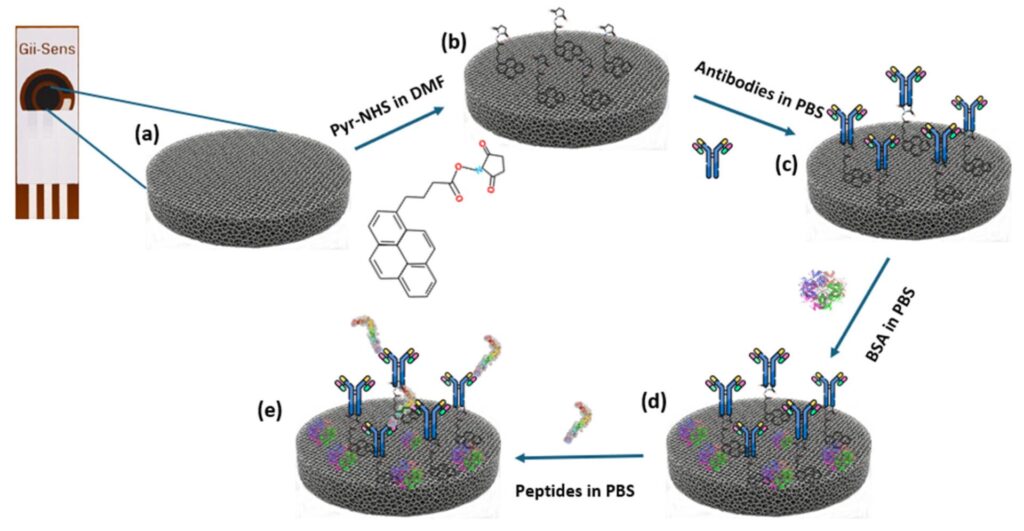
In this work, we developed assays on three-dimensional (3D) graphene foam electrodes by functionalising them with a 1-Pyrenebutyric acid N-hydroxysuccinimide ester (Pyr-NHS) to enable effective antibody immobilisation for the detection of amyloid beta peptides (Aβ42 and Aβ40), key biomarkers for AD.
Pyr-NHS linkers were used for stable functionalisation, followed by binding with Aβ42 and Aβ40 antibodies, and then bovine serum albumin (BSA) was employed as a blocking agent to minimise non-specific bindings on the electrode surface.
Differential Pulse Voltammetry (DPV) measurements showed satisfactory stability over 12 days (RDS upper limit was <10%) and highly sensitive and specific detection of Aβ42 and Aβ40, with insignificant interference of tau217 protein.
The biosensor exhibited a low limit of detection (LOD) with 252 aM for Aβ42 and 395 aM for Aβ40, covering 0.125 fM–1 nM and 0.125 fM–100 pM linear ranges, respectively. Further validation was conducted on spiked-diluted human plasma.
This excellent analytical performance was attributed to the stable Pyr-NHS functionalisation, the 3D graphene foam enabling superior conductivity and a larger surface area on the working electrode, and the optimisation of antibody concentration for immobilisation.
These promising results suggest that 3D graphene foam-based biosensors have considerable potential for early detection of AD biomarkers and developing cost-effective, portable, and reliable point-of-care devices.
Introduction
Dogan, Muhsin, Sophia Nazir, David Jenkins, Yinghui Wei, and Genhua Pan. 2025. “Electrochemical Detection of Aβ42 and Aβ40 at Attomolar Scale via Optimised Antibody Loading on Pyr-NHS-Functionalised 3D Graphene Foam Electrodes” Biosensors 15, no. 12: 806. https://doi.org/10.3390/bios15120806